Saturday, December 3, 2011

Updates from up above.

Looking up into the skies, wishing, wanting and worrying about finding something other than a glimmering star or wandering plane; I realize that I'm not alone.

Sometimes we find ourselves, looking inward for answers and receiving answers far more fetched than we intended them to be. Yet, we muster up the power and energy from within to keep on trucking.
The friendster union would be happy to hear me say - Keep on trucking, but occasionally I want to halt and slam on the brakes, look over my shoulder and see if any thing is behind me...

I then realize it's not what's behind me or in the past that I'm actually looking for, it's the answers to my questions.
Questions I just haven't had answered.

I suppose I'm really the only one who can answer these questions.

Or am I?

In a meditation I find myself in a field with a beautiful being who seems to be a male;
long blonde hair, glistening white skin and pointed ears.
We embrace, and I feel love flood my entire being and body,
my eyes shift to a forest not far from where we stand in this field;
there fly fairies, and dance small beautiful people singing songs.
Animals peruse the land and forest and the skies glisten with a starry night.

Any questions asked are all mentally and answered telepathically.
Where am I supposed to be?
Why am I here?
Is this a vision?

My new love being friend speaks his name,
in which I cannot remember at this time; 
but I know his face.
I see a silver shaped flying craft, and he has to leave right as I get comfortable with where I'm at,
who I'm with and the place we had met in.
And in this moment, I realize...I will see him again.


I wish and want to see his face once more and I hope for more answers.
Answers in which only I can dissect and figure out what they really mean.

Energy updates, and astrological predictions remain in my box of electronic emails,
open eyes, hands and a heart remain in my life.

I suppose what I'm saying is, I feel something spectacular coming,
a change of changes,
and am I ready?

Ready as I'll ever be.


- J-

Saturday, June 11, 2011

Herbs for your health.

An herb is a plant that is valued for flavor, scent, medicinal or other qualities. Herbs are used in cooking, as medicines, and for spiritual purposes. 


Today's Herb of the day: is Basil.


Basil is often used therapeutically for arthritis, anxiety, colds, depression, stress, respiratory challenges, and stomach aches. Basil has expectorant and calmative properties to it. Basil is great for expelling mucous from the body, therefore it is often used when one may have some chest congestion or nasal congestion. As an expectorant, it will help to rid this waste from the body and cleanse it. As a calmative, basil helps to ease and calm the senses - so it is great when one is feeling anxiety, stress or needs some calming. It is also great for soothing a weary mind or an upset stomach. 

Here are some ways to enjoy basil:
1) Eat it - throw it in salads, make a pesto, put it in foods! mmmm. basil!


2) Drink it - make a basil tea/infusion either by adding 3 teaspoons of dried basil to 1 cup of boiling water and let it sit (the longer you let it sit the stronger) or about 1 cup of fresh basil into 1 cup of boiling water and let it sit. Remember to boil the water and then remove from flame and then add the basil and let sit. Adding honey, or stevia will sweeten this basil tea up a notch.


3) For nasal congestion, boil a pot of water and add some essential oil of basil to the pot (about 7 drops) and let your head hang over the pot. Breathe in this aromatic vapor and feel the congestion melt away.4) For tired feet, soak 2 cups of fresh basil in 2 liters of water - allow to sit, then slip tired feet into the mixture and enjoy. Feel rejuvenated and also enjoy the antibacterial quality of basil as it cleanses the feet of any germs.


Basil for today folks.
Namaste.


Tuesday, June 7, 2011

Ginger and it's amazing benefits.

Ginger is an ancient treasured spice. For thousands of years, Asians have employed ginger not only as a pungent spice, but also as a medicine for stomachache, diarrhea, and nausea. Did you know that research also suggests ginger can be used for many other ailments? Take a look!
Migraines: ginger may have the ability to stop prostagldins from causing pain and inflammation in blood vessels.
Ovarian Cancer: ginger powder may induce death in ovarian cancer cells.
Colon Cancer: ginger may slow the growth of colorectal cancer cells. Diabetic Nephropathy: ginger may decrease the incidence of diabetic nephropathy (kidney damage).
Pain and Inflammation: ginger reduces your synthesis of prostaglandins and thromboxanes, which would otherwise cause pain, inflammation and blood clotting.
Tips and Tricks:
Fresh ginger root looks a bit strange in the grocery store. It is usually found next to the garlic or shallots. If the ginger is really fresh you should be able to scrape off the skin with a spoon. Otherwise, you will have to slice the skin off with a knife to uncover the yellow flesh.
If you have never tried fresh ginger, a great way to introduce it into your diet is to add a teaspoon of grated or chopped ginger to a stir-fry with some garlic and onions.
Are you feeling a bit of heartburn or slightly nauseous? Try taking 1, 1-inch piece of ginger and letting it steep in some boiling water for 15 minutes to make a ginger tea. You could also add a 1-inch piece to your favourite green or white or herbal tea to add a bit of spice!

Carrot Ginger Dressing

This dressing will make any salad taste delicious with the perfect balance of sweet to a little bit of zing. It is also delicious over steamed vegetables and brown rice. 
Makes approximately 1 cup
Ingredients:
1 large carrot
1-inch piece peeled ginger (about 1 tsp)
1 small shallot
4 Tbsp rice vinegar
1 Tbsp honey
1/2 cup olive oil/ flax oil/ or hemp oil
Puree carrot, ginger, and shallots in a food processor. Add the vinegar and honey. Blend very well. Add oil in two batches. Blend. Store in refrigerator.
References:
1.             Phanuef H. (2005) Herbs Demystified: A Scientist Explains How the Most Common Herbal Remedies Really Work. New York: Marlow & Company.
2.             Kloss J. (2008) Healthful Herbs from Back to Eden. East Sussex: Ivy Press.

Friday, June 3, 2011

The importance of loving one's self.

We spend so much time waiting to be loved, hoping love will find us, searching, yearning for that special love. Feeling empty and lost without it. Wanting someone to give us love and fill us up. In all reality,things don't work like that. 


It is through loving one's self that love is attracted. What does loving yourself mean?
Basically, Loving one's self is having self respect and love in which is sharable with others in your life.
When you expect love in your life from external sources, usually something different happens,whether it be a misfire, a miscommunication or a miss altogether. It is here in this circumstance in where we find ourselves with an empty void, not filled with the love we so desired and feeling worse; all because we didn't love ourselves first.


Here are a couple of simple tips to help your SELF along with this process,


  • The way you treat yourself, and see yourself, is the way others will treat you and see you.
  • Treat others as you'd like to be treated, WITH LOVE AND RESPECT!
  • Bring about kindness and good will by performing random acts of kindness
  • Forgive yourself when necessary; when you're feeling you're not worthy of love.
  •  Post affirmations: Such as "I am worthy of love." "I love myself today and everyday."
  • Let go of past events
  • Think about what you really want in life.
  • Keep a journal or blog
  • Steadily work at and on loving and accepting yourself as you are.
  • Get Started (You become what you think about, act upon and do.)
  • Raise your motives, and aim higherANDDDDDDDDDDDD Finally,
  • HUG YOURSELF!


With these simple steps, loving yourself can make the world an easier place,
and make you easier on the world.
<3


MORE Self Love TIPS:

  • Remember that you are human because sometimes we feel like outcasts or weirdos, but that is just something that makes you unique and to be human is to be imperfect.
  • Here's something to try saying every day. Place it on your mirror. It always helps: "Look in the mirror and what do I see? A handsome boy staring back at me!" "Oh wow!" I thought. Who could that be? [smile and say] "Oh! It's most definitely me!"
  • Make a list of the things you could love about yourself, ie: things you've done that if you saw someone else do them, you would love them. For instance, if you scored more in basketball, write it down, then eventually you can build up more pros, to help you know why to love yourself (if you're analytical).
  • Practice Metta meditation. It will help you love yourself and others more.
  • Just don't become vain, vanity is not loving yourself, as you love others.
  • Do what you enjoy. Go out somewhere, perhaps, with someone. Or stay at home, prepare yourself a nice meal and settle down with a good book in front of a cozy fire, a fan or air conditioner.
  • Every time you realize a negative emotion, pause and feel it; then thank yourself for feeling it, accepting it. Emotions are nothing more than internal experiences which contribute to who we are. Accepting problems (negative things) as opportunities (good things) in another perspective can yield great results (problem solving).
  • Mirrors will be your friend in this process. Seeing yourself as lovely and worthy of love is extremely important. Pick a favorite characteristic about yourself, and determine what exactly you don't like about yourself. Then proceed to fix these imperfections.
  • Never EVER EVER EVER expect to be like someone else 100%. Use your life to build a mysterious and appealing YOU. Not a remake of someone else which turns people away. Write a diary of your exciting and unique life!
  • Listen carefully to the messages you are sending for yourself. Turn off negative messages or turn them into a positive messages.
  • Treat yourself like the most loving parent would


WARNINGS:

  • Misery loves company, so do not hang-around unhappy, frowning and grouchy people."
  • Loving oneself is different from self-adoration or narcissism, which are negative and a huge turn off to others as they involve placing oneself above others.
  • Loving yourself does not mean grabbing all of the attention and becoming selfish. It is actually a golden confidence that whispers, I know when it is my time to shine and I can become selfless.
  • Remember The best way to love yourself is to trust who YOU are, YOU have all the answers for you.
Namaste.


Wednesday, June 1, 2011

What is a wounded Healer?

Wounded healer is an archetypal dynamic that psychologist Carl Jung used to describe a phenomenon that may take place in the relationship between analyst and analysand: 'Jung...warned of its dangers as well as its necessity'.
(Archetype:is a universally understood symbol or pattern of behavior, a prototype upon which others are copied, patterned, or emulated.)
In Greek mythology, the centaur 'Chiron was known as the "Wounded Healer" because he was poisoned by one of Hercules's arrows' by dropping it on himself. Unfortunately, 'Chiron was unable to heal himself and so suffered the pain of an incurable wound'.
It is also possible that Jung derives the term "wounded healer" from the ancient Greek legend of Asclepius, a physician who in identification of his own wounds creates a sanctuary atEpidaurus in order to treat others. By contrast, the figure of 'Apollo Medicus could be said to subvert the ancient folkloric motif known in Jungian discourse as the "wounded healer": the physician whose "own suffering and vulnerability...contribute crucially to the capacity to heal"'
Practial Reasoning:
The following is an example of the "wounded healer phenomena" between a analyst and his/her analysand:
  • The analyst, through the nature of his profession is consciously aware of his own personal wounds. However, these wounds may be activated in certain situations, especially if his analysand's wounds are similar to his own. (This can be the basis of countertransference).
  • In the meantime, the wounded analysand "inner healer" is unconscious to him, but potentially available.
  • The analysand's wounds activate those of the analyst. The analyst realizes what is taking place, and either consciously or unconsciously passes this awareness back to his analysand.
  • In this way, an unconscious relationship takes place between analyst and Client.
 This type of depth psychology can be potentially dangerous, because the analyst is vulnerable to being infected by his analysand's wounds, or having his or her wounds reopened. Also, the analyst must have an ongoing relationship with the unconscious, otherwise he or she could identify with the "healer archetype", and create an inflated ego.

Keeping an open heart, and on going relationship with consciousness, being a wounded healer has helped me personally grow closer to the universal energy of all that is, to myself and to humanity itself as a whole. I work very hard every day with my inner guidance system, and open heart to keep my ego at bay. It is a constant work in progress.
 That said, I am thankful to experience and have experienced everything in my life, wounds, scars, ups and downs, for without it; I would be incomplete.


Namaste.

Tuesday, May 31, 2011

Guided Meditation and It's Benefits!

Stress is one of the leading causes of physical and emotional breakdown in people and so managing this stress can have a considerable impact on our health and well being. The benefits gained when practicing guided meditation are those that are barely noticeable, happening silently in your subconscious mind with no conscious knowledge. In order to better understand how guided meditation will aid your health, you need to understand some basic terminology and the first is Homeostasis. This term refers to the process of your various physiological systems collaborating to properly manage the peak environment for your internal system functionality. In other words, this is your body doing its best to achieve a balance.
Everyone’s body is engineered with eleven main organ systems. Let us look at those organ structures to help you understand better the intricacies of this meditative course of action.

• Integumentary – (epidermis or skin);
• Skeletal;
• Muscular;
• Nervous;
• Endocrine – [hormones];
• Circulatory;
• Lymphatic – [disease immunity];
• Respiratory;
• Digestive;
• Urinary;
• Reproductive.


For each second that you are alive, these systems are continuously at work, scrutinizing your body and constantly making modifications to every one of these systems.
The Astounding Human Body
As a matter of practicality, when we consume food, the body is compelled to produce particular enzymes and concentrate the flow of blood so that digestion may occur. When you do aerobic exercise, your body needs to regulate your body temperature to prevent you from overheating. When you draw blood because of an accident of some kind, a number of your systems join forces to mend the spot you injured and to defend against any infection. The obvious instances are the most common to contemplate.
However, think about your body under stress. When you are in a stressful situation there is no physical display of damage – at least not one that can be easily spotted like a gash or bruising. Focus your mind’s eye on a potential deadline, monetary crisis or personal strife; you know this absolutely influences your functionality. You feel your body compensating by becoming physically exhausted or some other response. The body is continuous in its monitoring and modifies to any number of influential reactions.
The process of Homeostasis is continuously vigilant in an attempt to aid in maintaining a balance.
Other terms you need to understand have to do with your autonomic nervous system. They are partitioned into two divides – the sympathetic and parasympathetic. In layman’s terms, it means you are in one or another of “Fight or Flight” form or “Rest and Digest” form.
The best analogy to aid in better understanding this dates back to prehistoric time. Early man needed to stand and fight to kill in order to eat or Run [Flight] from the dangerous animal so mealtime was not suddenly reversed! Adrenalin surged in his system regardless of his choice. That is existing in the sympathetic nervous system.
When things finally calmed down, he was able to sit quietly in his habitat, stirring the fire with his spear for some enjoyment. He was able to unwind. He was not a slave to an employer, there were no ringing telephones, bill collectors and he was able to lay back and relax. This is the parasympathetic form of existence.
The world we exist in today is downright frantic in comparison – so many of us settling into “go mode”. Stress has become a common occurrence. How often do you hear yourself or others complain of needing a holiday; momentarily seeing yourself relaxing on a secluded beach with a pineapple full of some exotic cocktail when suddenly you come crashing back to reality. There is no time, no additional money and you have responsibilities! Shame on you for even thinking that way…
However, if you remain in fight or flight form for an extended period of time your body becomes exhausted. There is evidence to prove this fact. When you are under a bombardment of stress, your body is more likely to succumb to illness and ill health – physically and emotionally. It is the simplest thing to get caught up in a downward spin due to excessive stress. It is human nature and a personality trait of those who are susceptible to stress to work even harder though they feel lousy. They will continue to do their job as they would if they were in peak condition, which they are not.
Your performance will suffer, any task you perform is difficult, mistakes are easier to make and in the end, you create even more work. Who reading this has never been there? Working even harder to get the job done even though we are operating at a distinct disadvantage is a common trap. We allow our work to consume us, put in longer hours and sacrifice much enjoyment in our lives. We do this so we can either keep our jobs, or simply have more things we think we need.
The slope you are navigating is covered in ice. When you become this ensnared in your stress, often the only thing that will pull you from your spiral is an illness or health scare of some variety. It is your body’s way of letting you know it needs a breather. No doubt, it is tough, but very true.
Hence, another look at Homeostasis. The body calibrating itself. The balancing of all of life’s influences. There will be occasions when you find it necessary to run around with your hair on fire – often quite exciting times and memorable for their fun and achievement. Nevertheless, what about resting and digesting? [This does not mean unbuckling your belt in front of the television after a big meal!]
At what point do you find the time to flee from the circumstances of your stress and take some time for just you?
When you do find the time for a balance adjustment, understand that it is better in repeated amounts. Finding just short but recurrent reprieves from your stress is critical. Finding the discipline to regularly take a break where you do nothing is giving yourself the gift of opportunity to improve your life and add quality to it.
Meditation is a magnificent method to aid Homeostasis. Guided meditation allows your mind to follow the words to a story, allowing you to disengage for a short period from your average daily routine.
When your mind is being diverted, your body is submitting to relaxation and your eleven systems can concentrate on your health and well being. When you commit to practice, you will only need a minute to calm down toward your curative parasympathetic nervous division.
Certain benefits from meditation will be palpable and instantaneous. You will find your breathing becoming deeper; you will feel less weighted and rejuvenated. However, the secret benefits you derive from meditation work quietly in the shadows of your physiology – longevity and quality health.
Be certain of this, guided meditation is great for a person. Do more than understand that balance is vital to your life – put it into practice. Find ten minutes – three times each day and make a difference in your life that you will feel immediately.

Namaste.

Monday, May 30, 2011

Kids and Massage Therapy


Today's question is, How can massage benefit kids?

Massage for children offers a variety of health benefits. It is human nature to touch as a way of showing love and affection. This touch stimulates the body in positive ways to help it grow and develop. Massage is beneficial at any age but because children are still developing it can be especially helpful for them. Parent-child massage is a wonderful way to bond with your children while offering them health benefits.


Infant Weight Gain


Premature babies often struggle with weight gain. Touch, obtained through gentle massage and cuddling, releases a growth hormone in a premature infant that helps him gain necessary weight and aids development of vital organs and the brain. A study by the Department of Neonatology at the Children's National Medical Center in Washington, D.C. showed that premature infants who were massaged, particularly with kinesthetic stimulation (body stroking and passive movement of the limbs), gained more weight.

Stress and Anxiety Relief


Massage reduces stress hormone levels and blood glucose levels. According to Maria Hernandez-Reif, a researcher at the Touch Research Institute, lower stress hormones not only reduce feelings of anxiety but contribute to a healthier immune system. The immune system fights illnesses by defending the body against toxins, parasites, bacteria, microbes, pathogens and viruses. Due to its relaxing effect, massage has been found to reduce asthma symptoms in children and help them adhere to a sometimes painful diabetes treatment program.

Stimulates Motor Development

Children are developing their motor (movement) skills as they grow. Massage helps ease tension and pain in developing muscles that make motor skills possible. A study by the University of Miami indicates that massage improved motor function in children with Down syndrome, and the Journal of Pediatric Psychology reports that massage improved motor ability in children infected with HIV.

Stimulates Cognitive Development


According to Early Child Development and Care, preschoolers performed better on an IQ test following a 15-minute massage than they did from reading books. The International Journal of Neuroscience reported that massage improved function in the brain, resulting in increased alertness as well as speed and accuracy during math problems. 

See! Massage really can benefit the whole family!


Namaste.

Tuesday, May 24, 2011

Heart Meditation.

How to meditate from the Heart

Whatever your personal situation right now, meditation can help you to feel greater calm and inner peace. Instead of using your outer will to transform your life, meditation helps you to access your "inner voice" or guide. Some like to refer to this 'inner voice" as your Heart. Your Heart knows what's correct for you, but its voice is often drowned out by the confusion reigning in the mind. Meditation helps quiet the mind so you can listen to your Heart. By listening to our Heart we can experience greater peace and better health which in turn bring us more fulfilled and balanced lives. (Taken from Fragrant Heart.com)

Visit Many different websites for free guided heart mediations,
or simply find a quiet room or space you can be alone; close your eyes and simple ask your heart aloud or silently what it is that you need answering.
There after if necessary, write these things that come to mind down, regardless of how much sense they make, and move forward from there.

Although writing these things down is not necessary it does help with helping manifest the positive into our lives that we need by seeing it in front of us.


A few websites to begin this heart mediation journey:
(These are safe to click)


You may wonder why this whole post is in green -
Green is the color of the heart chakra, located in the center of our chest; just below our throat's center.
Envisioning a green light vortex spinning and surrounding you with green healing light while meditating is also a beautiful healing practice.
Good Luck and may you from here on out come from, live from and speak from the heart.<3

Namaste. 

Wednesday, April 27, 2011

Water & You.

H20. We all know we need to drink it, and LOTS of it. But why?

An increased intake of healthy water will greatly enhance digestion‚ nutrient absorption‚ skin hydration‚ detoxification and virtually every aspect of better health!
So many common ailments and illnesses can be prevented and possibly even cured with an increased intake of healthy water. Headaches, hypertension, back pain, arthritis, ulcers, asthma, morning sickness and fatigue can all benefit and in many cases be prevented by regulating the body’s natural fluid levels. Recently there has been a dramatic swing in medical theory and a long overdue realization about “healing”. The best way to prevent, treat and in many cases cure illness is to give our body the right tools and let it go to work. With the proper intake of healthy water, the right minerals and nutrients our body can over come almost anything.

Recent studies have confirmed that many of the medications our society has become dependant on, primarily antibiotics and pain relievers , often do more harm than good. Antibiotics can be extremely damaging to the liver and have an adverse effect on our natural immune system. The more often we turn to synthetic medicines to over come infections, the weaker our natural defenses become and the more likely we are to have repeated incidences of infection. An increased intake of water and the proper immune enhancing nutrients combined with a little patience and common sense are by far the best defense against most infections. Allowing our body to over come minor infections with fever, fluids and rest increases our natural resistance and makes us less susceptible to these intruders in the future. Truly the best offence is a good “defense”.

Pain medications and analgesic medicines also work in contrast to the way our body heals itself. In a very informative book called The Body's Many Cries for Water (very highly recommend) studies by medical experts explain how most of the pain sensations we experience are the result of moderate or acute dehydration.

Our brain is over 75% water and when it detects a shortage of available fluids it implements a water rationing process by producing histamines, causing pain and fatigue. This natural process is meant to slow us down and conserve water. Histamines are released as a warning signal that something is wrong. When we take antihistamines or analgesic medicines like acetaminophen or ibuprofen we simply turn off the signal and often allow the problem to progress. Two cups of water and a 20 minute break will overcome most common headache pain.

Back pain is also most often the result of a deficiency in body fluid levels. The disks in our back are in reality little hydraulic shock absorbers. These disks are made up of an outer shell filled with fluid, primarily water. A properly hydrated disk creates a cushion that absorbs the shock of physical activity and supports the weight of the upper body. These discs are self hydrating as long as there is adequate fluid levels and regular movement. Movement that compresses and releases pressure on the disc creates a suction that allows water to be pulled inside the disc keeping it fully hydrated. When a disc is fully hydrated the shell of the disc supports 25% of the weight load and the fluid supports 75%. When theses discs become dehydrated then the shell has to support a larger portion of the load causing pain, swelling and soreness. Passive activities like standing, or sitting at a desk without regular movement, allow constant pressure on the disks which slowly forces water out. Without sufficient fluid levels, the pressure on the disc increases and results in pain and stiffness. Simply by maintaining a constant and adequate intake of water combined with regular movement such as bending forward and backwards with your head and upper body allowing the disks to hydrate, you can prevent and stop most minor back and neck pain. Try it, you’ll be amazed how easy and effective these natural solutions are.

Hypertension is very often a result of the body adjusting to blood volume loss, according to Dr. Batmanghelidj, MD, a recognized expert on natural and preventive treatments. The most common cause of lower blood volume is dehydration. Since our blood is more than 83% water it’s total volume is heavily effected by the level of available water in our body. When the body detects a loss of blood volume it closes off less active capillary beds in order to maintain proper blood flow to the more active areas. These vessel closings cause a rise in tension inside the muscle mass which we’ve come to know as “hypertension”. More water allows proper blood volumes and less tension.

Arthritis pain and stiffness is now understood to be initially a result of increased friction and swelling in the bone joints. Water is what our body uses to lubricate these joints. When our water levels are reduced there is increased friction between the cartilage surfaces resulting in swelling, stiffness and pain. The movement of the joints cause a suction that pulls water from the bone marrow to the joint cavity if there is available water. An increased intake of water and gentle rhythmic movements of the joints can ease and in many cases overcome minor arthritic pain. A more detailed explanation of this natural treatment can be studied in The Body’s Many Cries For Water or a recent publication by three very highly respected Medical Doctors called The Water We Drink. For more information on arthritis, read Glucosamine and Arthritis Pain

Asthma, which effects over 12 million children in North America alone and causes the deaths of several thousand each year, is a direct result of increased histamine production. Dehydration initiates exaggerated histamine production as a water regulating control. It is well known that asthmatics have excessive levels of histamines in their lung tissue causing constriction of the bronchial passages and increased mucus build up. Water is used in the lungs to keep the tissue moist, but each time we exhale we expel moisture from our lungs. Under normal hydrated conditions the moisture is rapidly replaced. If we are in a dehydrated state then the tissue inside the lungs begins to coat with mucus to prevent drying. It has been demonstrated in many animal studies that an increase in water intake will reduce histamine levels and over a 2 to 3 week period restore normal hydration to lung tissue and reduce mucus build up. Once this occurs the bronchial passages begin to open and normal breathing is restored. The same histamine related effects apply to allergies, and again, significant benefits can result from an increased intake of water.

Even something thought of as normal, like morning sickness is a direct result of dehydration. The fetus lives in a world of water which the body prioritizes above all other needs. Throughout the night, which is the longest period without water intake, the uterus draws water from the mothers system to maintain it’s internal fluid levels and those of the fetus. In the morning the mother awakens in a state of dehydration, nausea and fatigue, hence the term “morning sickness”. A common hang over produces the same symptoms and has essentially the same cause, dehydration… only with a much less noble purpose. Alcohol is a very strong diuretic and causes the body to excrete water often leading to advanced dehydration. Both of these common ailments can be prevented by drinking plenty of water before and throughout the night.

While water is not an absolute cure-all, it must be recognized as the base and primary ingredient to every preventive and healing process within our body. We are truly a magnificent creation capable of preventing and curing even the worst of disease and illness.

Understanding how our body works is the first step towards achieving a higher level of health. Once we have this understanding then our actions begin to work in harmony with our body’s natural instincts, creating the perfect internal environment.

It is important to remember that we are a water machine and that simply by providing our body with the proper ingredients we can and will achieve an elevated level of health, and what a wonderful and rewarding feeling it can be!

Wednesday, April 6, 2011

Today's Excerpt was brought to us Myo-fascial Release!

Some of you are probably thinking, What is fascia? And what the heck is myofascial release?
Well..
Fascia is a connective tissue that surrounds muscles, groups of muscles, blood vessels, and nerves, binding those structures together in much the same manner as plastic wrap can be used to hold the contents of sandwiches together.
Myofascial release is a form of soft tissue therapy used to treat somatic dysfunction and resulting pain and restriction of motion.

Self Myofascial Release Exercises

For these exercises you will need a foam roll (which is very inexpensive). You can get them from anywhere that sell sports medicine or physical therapy supplies. Online, try www.power-systems.comwho sell a variety of foam rolls.
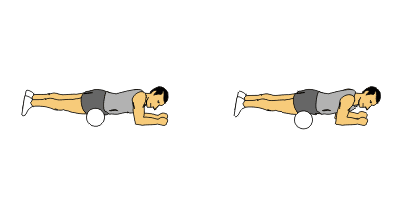
Self myofascial adductor stretchAdductor Self Myofascial Release
1. Extend the thigh and place foam roll in the groin region with body prone (face down) on the floor.
2. Be cautious when rolling near the adductor complex origins at the pelvis.
3. If a tender point is located, stop rolling, and rest on the tender point until pain decreases by 75%.


Self myofascial hamstring stretchHamstring Self Myofascial Release
1. Place hamstrings on the roll with hips unsupported.
2. Feet can be crossed so that only leg at a time is one the foam roll.
3. Roll from knee toward posterior hip.
4. If a tender point is located, stop rolling, and rest on the tender point until pain decreases by 75%.


Self myofascial quadriceps stretchQuadriceps Slef Myofascial Release
1. Body is positioned prone (face down) with quadriceps on foam roll
2. It is very important to maintain proper core control (abdominal drawn-in position & tight gluteus) to prevent low back compensations
3. Roll from pelvic bone to knee, emphasizing the lateral (outside) thigh
4. If a tender point is located, stop rolling, and rest on the tender point until pain decreases by 75%.


Self myofascial IT band stretchIliotibial Band Self Myofascial Release
1. Position yourself on your side lying on foam roll.
2. Bottom leg is raised slightly off floor.
3. Maintain head in neutral position with ears aligned with shoulders.
4. This may be PAINFUL for many, and should be done in moderation.
5. Roll just below hip joint down the outside thigh to the knee.
6. If a tender point is located, stop rolling, and rest on the tender point until pain decreases by 75%.


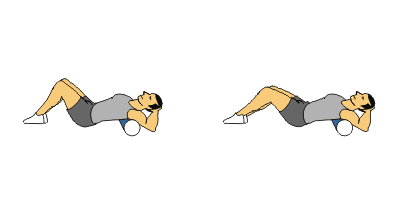
Self myofascial upper back stretchUpper Back Self Myofascial Release
1. Place hands behind head or wrap arms around chest to clear the shoulder blades across the thoracic wall.
2. Raise hips until unsupported.
4. Stabilize the head in a neutral position.
5. Roll mid-back area on the foam roll.
6. If a tender point is located, stop rolling, and rest on the tender point until pain decreases by 75%.

General Guidelines

  • Spend 1-2 minutes per self myofascial release technique and on each each side (when applicable).
  • When a trigger point is found (painful area) hold for 30-45 seconds.
  • Keep the abdominal muscles tight which provides stability to the lumbo-pelvic-hip complex during rolling.
  • Remember to breathe slowly as this will help to reduce any tense reflexes caused by discomfort.
  • Complete the self myofascial release exercises 1-2 x daily.

    The Fascia structure is similar to that of a sail boat, or a loose thread on a sweater.
    If one piece is being pulled, the rest follows.
    Water, stretch and massage those muscles!


Tuesday, April 5, 2011

The Human Body & it's ability to heal ITSELF.

We've all heard it, talked about it or were curious about it.
The Human Body's ability to heal itself.
Plenty of Holistic Practitioners have been preaching for years.
But what is all this stuff they're talking about anyway?


The make up of the inside of me?
How's it all work?

Well With the help of Dr Goldhamer.


How Your Body Heals Itself


Author CREDIT: 
 Dr. Alan Goldhamer
Understanding the extraordinary power of your immune system! The more you know about how your body works, the better able you are to make the choices necessary to enhance both the quantity and quality of your life!

Hygiene is defined in the dictionary as the science of health and its preservation. But what does that really mean?

Science, the dictionary tells us, is "the systematic observation of natural phenomena for the purpose of discovering laws governing those phenomena." Put more simply, science is the process we use to figure out how things work. Health is defined as "a state of optimal physical, mental, and social well-being."

With these definitions in mind, it is easy to see that Hygiene is neither a dietary system, a therapeutic system, nor a religious or belief system. Hygiene is the science of health. It encompasses a broad body of knowledge about the natural laws that determine health and numerous techniques that enable you to use this information to maximize your health potential.

Knowledge is power

The more you learn about how your body works, the better prepared you will be to make the choices necessary to enhance both the quantity (longevity) and quality of your life.

The optimum state of function that we call health is spontaneously generated by the human organism when it is provided with the requirements of health. The requirements of health can be conveniently classified into four general categories:

Diet - a plant-based diet of whole natural foods that meets your individual nutritional needs;

Environment - getting fresh air, pure water, and appropriate sunshine, and avoiding environmental stressors such as air and water pollution, and excess exposure to dust, pollen, chemicals, and noise;

Activity - engaging in regular aerobic exercise and getting adequate rest and sleep; and

Psychology - engaging in productive activity and developing the interpersonal social skills necessary for a successful life.

When the requirements of health are appropriately provided, the self-healing mechanisms of the body attempt to restore and/or optimize health. Your body's ability to do this is only limited by your inherent constitution (genetics) and the amount of use and abuse that has taken place.

Hygienic physicians have always emphasized the concept that health and disease are not antagonists. Disease processes such as diarrhea, fever, and inflammation are not only natural, but are necessary attempts by the body to regain optimum health. Attempts to suppress these adaptive and eliminative processes with drugs and other invasive treatment may create problems by interfering with the body's self-healing mechanisms.

Natural immunity

It is important that you know how extraordinarily capable and complex your immune system is.

Your body is constantly exposed to chemicals, toxins, pollutants, and other stressors. In addition, simple organisms such as viruses, bacteria, fungi, and parasites are capable (under certain circumstances) of invading the human body and using it as a source of nourishment. Fortunately, the healthy human body has defenses against invasion by these organisms. These defenses comprise the immune system.

The immune system can be thought of as having two divisions-the general or non-specific immune system and the adaptive or specific immune system.

Your non-specific immune system

First let's take a look at the non-specific division of the immune system. The largest organ in the human body is not the heart or liver; it is the skin. The skin and its components form a very important part of the non-specific immune system.

Most potentially pathogenic organisms and agents are prevented from interfering with normal function because of the barrier that the skin creates. The openings into the body, such as the mouth and nose, however, are not covered with skin, but with mucus membrane. This membrane can secrete various substances and is usually moist. In these moist secretions are other defense mechanisms, including chemicals such as lysozyme and C reactive protein, which can kill invading bacteria.

Mucus itself can trap invading organisms, and cilia (little hairlike projections in the lungs, bronchi, and throat) can push those invaders back out of the body as long as they are working properly. It has been shown that in tobacco and marijuana smokers the cilia become paralyzed and destroyed. This is one of the reasons that smokers have such an increased incidence of respiratory and other infections.

The acid in the stomach, vagina, and other organs also can act as part of the non-specific immune system by creating an environment in which potentially invasive organisms cannot survive.

Look who's coming for dinner

The next components of the non-specific division of the immune system are the phagocytic or "cell-eating" cells. These phagocytes can engulf and destroy most invading organisms. Phagocytes are a type of white blood cell found in the bloodstream as well as in various organs such as the lungs, liver, and intestinal tract.

People with malfunctioning phagocytes are subject to recurrent infections. In rare cases, this malfunctioning is a genetic defect. More commonly, it arises from poor health practices which overwhelm the ability of the phagocyte to act. Smoking, for example, in addition to paralyzing cilia, can kill macrophages, the phagocytes that live in the lungs.

Natural born killers

Another type of white blood cell, called the "natural killer" cell, can recognize cells that have been invaded by viruses. The killer cells can bind to these infected cells and destroy them. Cells that are infected by viruses help the killer cells by producing chemicals called interferons, which activate the killer cells.

The body also is capable of producing special proteins during an infection. These proteins coat the invading organisms, especially certain bacteria, and make it easier for the phagocytes to destroy them. But this only works if the invading organisms have some general chemical markers that the non-specific division of the immune system can identify.

Some like it hot

When an infection or injury takes place, the body produces a reaction called inflammation. Inflammation serves to direct the elements of the immune system to the site of infection or injury.

Inflammation consists of three parts-increased blood supply to the infected area; increased permeability of the small blood vessels permitting large molecules to leave the bloodstream and reach the infection; and increased migration of phagocytes toward the site of infection. Inflammation causes the infected area to look red, become swollen, and feel hot and painful.

The non-specific division of the immune system, including skin, mucus, cilia and phagocyte can take care of many infections and potential infections. Problems arise when phagocytes lack the ability to identify things that bypass the non-specific division of the immune system's defenses.

Your specific immune system

Fortunately, the immune system has another division called the adaptive, or specific, division. Unlike the non-specific division, the specific division of the immune system is capable of producing particles called antibodies.

These tiny antibodies have two ends. One is a receptor that can recognize a specific organism or substance. The other end is a marker that fits in the general receptors of the phagocytes. When an antibody attaches its specific end to an invading organism or foreign substance, it tags the invader in such a way that the phagocytes of the non-specific division of the immune system can recognize and destroy it.

These antibodies made by the specific division of the immune system are produced by white blood cells called B lymphocytes. B lymphocytes come in thousands of varieties, each capable of recognizing one specific marker or antigen.

The number of lymphocytes that can recognize any particular marker or antigen is very small. When the right B lymphocyte finds the antigen of the invader, it binds to it. This stimulates the lymphocyte to quickly reproduce many more B lymphocytes of exactly the same type.

With the help of a complicated chemical signaling system, the new B cells are ordered to start pouring out antibodies. The antibodies bind to the invaders, and the phagocytes destroy them. Some of the new B cells, instead of producing antibodies, become memory cells. After the invasion is resolved, these memory cells persist in the body. If that particular invader should ever happen to show up again, the body will be able to destroy it quickly.

Mother's little helpers

In addition to the B lymphocytes that produce antibodies, there is another important kind of lymphocyte cell-T lymphocytes or T cells. T cells come in several varieties-helper, killer, suppressor, memory and others.

Helper T cells, like B cells are very specific, having specific receptors for specific invaders. It is the helper T cells that are in charge of the complicated chemical signaling system that tells the B cells what to do and initiates the production of killer T cells.

Love the one you're with

We are fortunate that we possess such a complex and efficient immune system that functions at its highest level when we conscientiously secure the requirements of health.

Your health is very precious. Take the steps necessary to protect and preserve it. Remember, you are the only you you've got.  


So take time for you,
Take time for your health, because really YOU'RE in control.


Namaste.