Today's Excerpt was brought to us Myo-fascial Release!
Some of you are probably thinking, What is fascia? And what the heck is myofascial release?
Well..
Fascia is a connective tissue that surrounds muscles, groups of muscles, blood vessels, and nerves, binding those structures together in much the same manner as plastic wrap can be used to hold the contents of sandwiches together.
Myofascial release is a form of soft tissue therapy used to treat somatic dysfunction and resulting pain and restriction of motion.
Self Myofascial Release Exercises
For these exercises you will need a foam roll (which is very inexpensive). You can get them from anywhere that sell sports medicine or physical therapy supplies. Online, try www.power-systems.comwho sell a variety of foam rolls.
 Adductor Self Myofascial Release
1. Extend the thigh and place foam roll in the groin region with body prone (face down) on the floor.
2. Be cautious when rolling near the adductor complex origins at the pelvis.
3. If a tender point is located, stop rolling, and rest on the tender point until pain decreases by 75%.
 Hamstring Self Myofascial Release
1. Place hamstrings on the roll with hips unsupported.
2. Feet can be crossed so that only leg at a time is one the foam roll.
3. Roll from knee toward posterior hip.
4. If a tender point is located, stop rolling, and rest on the tender point until pain decreases by 75%.
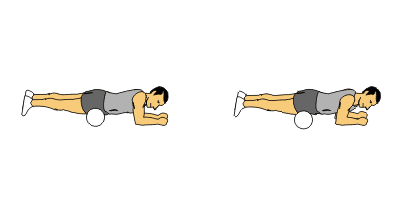 Quadriceps Slef Myofascial Release
1. Body is positioned prone (face down) with quadriceps on foam roll
2. It is very important to maintain proper core control (abdominal drawn-in position & tight gluteus) to prevent low back compensations
3. Roll from pelvic bone to knee, emphasizing the lateral (outside) thigh
4. If a tender point is located, stop rolling, and rest on the tender point until pain decreases by 75%.
 Iliotibial Band Self Myofascial Release
1. Position yourself on your side lying on foam roll.
2. Bottom leg is raised slightly off floor.
3. Maintain head in neutral position with ears aligned with shoulders.
4. This may be PAINFUL for many, and should be done in moderation.
5. Roll just below hip joint down the outside thigh to the knee.
6. If a tender point is located, stop rolling, and rest on the tender point until pain decreases by 75%.
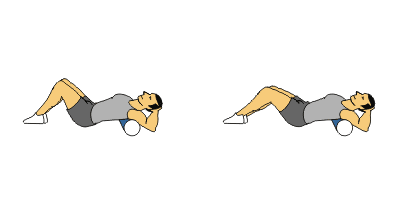 Upper Back Self Myofascial Release
1. Place hands behind head or wrap arms around chest to clear the shoulder blades across the thoracic wall.
2. Raise hips until unsupported.
4. Stabilize the head in a neutral position.
5. Roll mid-back area on the foam roll.
6. If a tender point is located, stop rolling, and rest on the tender point until pain decreases by 75%.
General Guidelines
- Spend 1-2 minutes per self myofascial release technique and on each each side (when applicable).
- When a trigger point is found (painful area) hold for 30-45 seconds.
- Keep the abdominal muscles tight which provides stability to the lumbo-pelvic-hip complex during rolling.
- Remember to breathe slowly as this will help to reduce any tense reflexes caused by discomfort.
- Complete the self myofascial release exercises 1-2 x daily.
The Fascia structure is similar to that of a sail boat, or a loose thread on a sweater.If one piece is being pulled, the rest follows.Water, stretch and massage those muscles!

No comments:
Post a Comment