Wednesday, April 27, 2011

Water & You.

H20. We all know we need to drink it, and LOTS of it. But why?

An increased intake of healthy water will greatly enhance digestion‚ nutrient absorption‚ skin hydration‚ detoxification and virtually every aspect of better health!
So many common ailments and illnesses can be prevented and possibly even cured with an increased intake of healthy water. Headaches, hypertension, back pain, arthritis, ulcers, asthma, morning sickness and fatigue can all benefit and in many cases be prevented by regulating the body’s natural fluid levels. Recently there has been a dramatic swing in medical theory and a long overdue realization about “healing”. The best way to prevent, treat and in many cases cure illness is to give our body the right tools and let it go to work. With the proper intake of healthy water, the right minerals and nutrients our body can over come almost anything.

Recent studies have confirmed that many of the medications our society has become dependant on, primarily antibiotics and pain relievers , often do more harm than good. Antibiotics can be extremely damaging to the liver and have an adverse effect on our natural immune system. The more often we turn to synthetic medicines to over come infections, the weaker our natural defenses become and the more likely we are to have repeated incidences of infection. An increased intake of water and the proper immune enhancing nutrients combined with a little patience and common sense are by far the best defense against most infections. Allowing our body to over come minor infections with fever, fluids and rest increases our natural resistance and makes us less susceptible to these intruders in the future. Truly the best offence is a good “defense”.

Pain medications and analgesic medicines also work in contrast to the way our body heals itself. In a very informative book called The Body's Many Cries for Water (very highly recommend) studies by medical experts explain how most of the pain sensations we experience are the result of moderate or acute dehydration.

Our brain is over 75% water and when it detects a shortage of available fluids it implements a water rationing process by producing histamines, causing pain and fatigue. This natural process is meant to slow us down and conserve water. Histamines are released as a warning signal that something is wrong. When we take antihistamines or analgesic medicines like acetaminophen or ibuprofen we simply turn off the signal and often allow the problem to progress. Two cups of water and a 20 minute break will overcome most common headache pain.

Back pain is also most often the result of a deficiency in body fluid levels. The disks in our back are in reality little hydraulic shock absorbers. These disks are made up of an outer shell filled with fluid, primarily water. A properly hydrated disk creates a cushion that absorbs the shock of physical activity and supports the weight of the upper body. These discs are self hydrating as long as there is adequate fluid levels and regular movement. Movement that compresses and releases pressure on the disc creates a suction that allows water to be pulled inside the disc keeping it fully hydrated. When a disc is fully hydrated the shell of the disc supports 25% of the weight load and the fluid supports 75%. When theses discs become dehydrated then the shell has to support a larger portion of the load causing pain, swelling and soreness. Passive activities like standing, or sitting at a desk without regular movement, allow constant pressure on the disks which slowly forces water out. Without sufficient fluid levels, the pressure on the disc increases and results in pain and stiffness. Simply by maintaining a constant and adequate intake of water combined with regular movement such as bending forward and backwards with your head and upper body allowing the disks to hydrate, you can prevent and stop most minor back and neck pain. Try it, you’ll be amazed how easy and effective these natural solutions are.

Hypertension is very often a result of the body adjusting to blood volume loss, according to Dr. Batmanghelidj, MD, a recognized expert on natural and preventive treatments. The most common cause of lower blood volume is dehydration. Since our blood is more than 83% water it’s total volume is heavily effected by the level of available water in our body. When the body detects a loss of blood volume it closes off less active capillary beds in order to maintain proper blood flow to the more active areas. These vessel closings cause a rise in tension inside the muscle mass which we’ve come to know as “hypertension”. More water allows proper blood volumes and less tension.

Arthritis pain and stiffness is now understood to be initially a result of increased friction and swelling in the bone joints. Water is what our body uses to lubricate these joints. When our water levels are reduced there is increased friction between the cartilage surfaces resulting in swelling, stiffness and pain. The movement of the joints cause a suction that pulls water from the bone marrow to the joint cavity if there is available water. An increased intake of water and gentle rhythmic movements of the joints can ease and in many cases overcome minor arthritic pain. A more detailed explanation of this natural treatment can be studied in The Body’s Many Cries For Water or a recent publication by three very highly respected Medical Doctors called The Water We Drink. For more information on arthritis, read Glucosamine and Arthritis Pain

Asthma, which effects over 12 million children in North America alone and causes the deaths of several thousand each year, is a direct result of increased histamine production. Dehydration initiates exaggerated histamine production as a water regulating control. It is well known that asthmatics have excessive levels of histamines in their lung tissue causing constriction of the bronchial passages and increased mucus build up. Water is used in the lungs to keep the tissue moist, but each time we exhale we expel moisture from our lungs. Under normal hydrated conditions the moisture is rapidly replaced. If we are in a dehydrated state then the tissue inside the lungs begins to coat with mucus to prevent drying. It has been demonstrated in many animal studies that an increase in water intake will reduce histamine levels and over a 2 to 3 week period restore normal hydration to lung tissue and reduce mucus build up. Once this occurs the bronchial passages begin to open and normal breathing is restored. The same histamine related effects apply to allergies, and again, significant benefits can result from an increased intake of water.

Even something thought of as normal, like morning sickness is a direct result of dehydration. The fetus lives in a world of water which the body prioritizes above all other needs. Throughout the night, which is the longest period without water intake, the uterus draws water from the mothers system to maintain it’s internal fluid levels and those of the fetus. In the morning the mother awakens in a state of dehydration, nausea and fatigue, hence the term “morning sickness”. A common hang over produces the same symptoms and has essentially the same cause, dehydration… only with a much less noble purpose. Alcohol is a very strong diuretic and causes the body to excrete water often leading to advanced dehydration. Both of these common ailments can be prevented by drinking plenty of water before and throughout the night.

While water is not an absolute cure-all, it must be recognized as the base and primary ingredient to every preventive and healing process within our body. We are truly a magnificent creation capable of preventing and curing even the worst of disease and illness.

Understanding how our body works is the first step towards achieving a higher level of health. Once we have this understanding then our actions begin to work in harmony with our body’s natural instincts, creating the perfect internal environment.

It is important to remember that we are a water machine and that simply by providing our body with the proper ingredients we can and will achieve an elevated level of health, and what a wonderful and rewarding feeling it can be!

Wednesday, April 6, 2011

Today's Excerpt was brought to us Myo-fascial Release!

Some of you are probably thinking, What is fascia? And what the heck is myofascial release?
Well..
Fascia is a connective tissue that surrounds muscles, groups of muscles, blood vessels, and nerves, binding those structures together in much the same manner as plastic wrap can be used to hold the contents of sandwiches together.
Myofascial release is a form of soft tissue therapy used to treat somatic dysfunction and resulting pain and restriction of motion.

Self Myofascial Release Exercises

For these exercises you will need a foam roll (which is very inexpensive). You can get them from anywhere that sell sports medicine or physical therapy supplies. Online, try www.power-systems.comwho sell a variety of foam rolls.
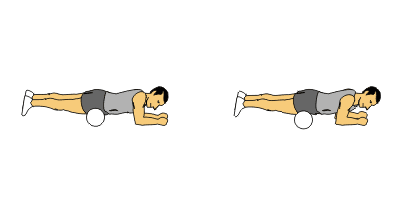
Self myofascial adductor stretchAdductor Self Myofascial Release
1. Extend the thigh and place foam roll in the groin region with body prone (face down) on the floor.
2. Be cautious when rolling near the adductor complex origins at the pelvis.
3. If a tender point is located, stop rolling, and rest on the tender point until pain decreases by 75%.


Self myofascial hamstring stretchHamstring Self Myofascial Release
1. Place hamstrings on the roll with hips unsupported.
2. Feet can be crossed so that only leg at a time is one the foam roll.
3. Roll from knee toward posterior hip.
4. If a tender point is located, stop rolling, and rest on the tender point until pain decreases by 75%.


Self myofascial quadriceps stretchQuadriceps Slef Myofascial Release
1. Body is positioned prone (face down) with quadriceps on foam roll
2. It is very important to maintain proper core control (abdominal drawn-in position & tight gluteus) to prevent low back compensations
3. Roll from pelvic bone to knee, emphasizing the lateral (outside) thigh
4. If a tender point is located, stop rolling, and rest on the tender point until pain decreases by 75%.


Self myofascial IT band stretchIliotibial Band Self Myofascial Release
1. Position yourself on your side lying on foam roll.
2. Bottom leg is raised slightly off floor.
3. Maintain head in neutral position with ears aligned with shoulders.
4. This may be PAINFUL for many, and should be done in moderation.
5. Roll just below hip joint down the outside thigh to the knee.
6. If a tender point is located, stop rolling, and rest on the tender point until pain decreases by 75%.


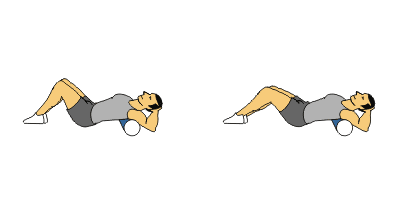
Self myofascial upper back stretchUpper Back Self Myofascial Release
1. Place hands behind head or wrap arms around chest to clear the shoulder blades across the thoracic wall.
2. Raise hips until unsupported.
4. Stabilize the head in a neutral position.
5. Roll mid-back area on the foam roll.
6. If a tender point is located, stop rolling, and rest on the tender point until pain decreases by 75%.

General Guidelines

  • Spend 1-2 minutes per self myofascial release technique and on each each side (when applicable).
  • When a trigger point is found (painful area) hold for 30-45 seconds.
  • Keep the abdominal muscles tight which provides stability to the lumbo-pelvic-hip complex during rolling.
  • Remember to breathe slowly as this will help to reduce any tense reflexes caused by discomfort.
  • Complete the self myofascial release exercises 1-2 x daily.

    The Fascia structure is similar to that of a sail boat, or a loose thread on a sweater.
    If one piece is being pulled, the rest follows.
    Water, stretch and massage those muscles!


Tuesday, April 5, 2011

The Human Body & it's ability to heal ITSELF.

We've all heard it, talked about it or were curious about it.
The Human Body's ability to heal itself.
Plenty of Holistic Practitioners have been preaching for years.
But what is all this stuff they're talking about anyway?


The make up of the inside of me?
How's it all work?

Well With the help of Dr Goldhamer.


How Your Body Heals Itself


Author CREDIT: 
 Dr. Alan Goldhamer
Understanding the extraordinary power of your immune system! The more you know about how your body works, the better able you are to make the choices necessary to enhance both the quantity and quality of your life!

Hygiene is defined in the dictionary as the science of health and its preservation. But what does that really mean?

Science, the dictionary tells us, is "the systematic observation of natural phenomena for the purpose of discovering laws governing those phenomena." Put more simply, science is the process we use to figure out how things work. Health is defined as "a state of optimal physical, mental, and social well-being."

With these definitions in mind, it is easy to see that Hygiene is neither a dietary system, a therapeutic system, nor a religious or belief system. Hygiene is the science of health. It encompasses a broad body of knowledge about the natural laws that determine health and numerous techniques that enable you to use this information to maximize your health potential.

Knowledge is power

The more you learn about how your body works, the better prepared you will be to make the choices necessary to enhance both the quantity (longevity) and quality of your life.

The optimum state of function that we call health is spontaneously generated by the human organism when it is provided with the requirements of health. The requirements of health can be conveniently classified into four general categories:

Diet - a plant-based diet of whole natural foods that meets your individual nutritional needs;

Environment - getting fresh air, pure water, and appropriate sunshine, and avoiding environmental stressors such as air and water pollution, and excess exposure to dust, pollen, chemicals, and noise;

Activity - engaging in regular aerobic exercise and getting adequate rest and sleep; and

Psychology - engaging in productive activity and developing the interpersonal social skills necessary for a successful life.

When the requirements of health are appropriately provided, the self-healing mechanisms of the body attempt to restore and/or optimize health. Your body's ability to do this is only limited by your inherent constitution (genetics) and the amount of use and abuse that has taken place.

Hygienic physicians have always emphasized the concept that health and disease are not antagonists. Disease processes such as diarrhea, fever, and inflammation are not only natural, but are necessary attempts by the body to regain optimum health. Attempts to suppress these adaptive and eliminative processes with drugs and other invasive treatment may create problems by interfering with the body's self-healing mechanisms.

Natural immunity

It is important that you know how extraordinarily capable and complex your immune system is.

Your body is constantly exposed to chemicals, toxins, pollutants, and other stressors. In addition, simple organisms such as viruses, bacteria, fungi, and parasites are capable (under certain circumstances) of invading the human body and using it as a source of nourishment. Fortunately, the healthy human body has defenses against invasion by these organisms. These defenses comprise the immune system.

The immune system can be thought of as having two divisions-the general or non-specific immune system and the adaptive or specific immune system.

Your non-specific immune system

First let's take a look at the non-specific division of the immune system. The largest organ in the human body is not the heart or liver; it is the skin. The skin and its components form a very important part of the non-specific immune system.

Most potentially pathogenic organisms and agents are prevented from interfering with normal function because of the barrier that the skin creates. The openings into the body, such as the mouth and nose, however, are not covered with skin, but with mucus membrane. This membrane can secrete various substances and is usually moist. In these moist secretions are other defense mechanisms, including chemicals such as lysozyme and C reactive protein, which can kill invading bacteria.

Mucus itself can trap invading organisms, and cilia (little hairlike projections in the lungs, bronchi, and throat) can push those invaders back out of the body as long as they are working properly. It has been shown that in tobacco and marijuana smokers the cilia become paralyzed and destroyed. This is one of the reasons that smokers have such an increased incidence of respiratory and other infections.

The acid in the stomach, vagina, and other organs also can act as part of the non-specific immune system by creating an environment in which potentially invasive organisms cannot survive.

Look who's coming for dinner

The next components of the non-specific division of the immune system are the phagocytic or "cell-eating" cells. These phagocytes can engulf and destroy most invading organisms. Phagocytes are a type of white blood cell found in the bloodstream as well as in various organs such as the lungs, liver, and intestinal tract.

People with malfunctioning phagocytes are subject to recurrent infections. In rare cases, this malfunctioning is a genetic defect. More commonly, it arises from poor health practices which overwhelm the ability of the phagocyte to act. Smoking, for example, in addition to paralyzing cilia, can kill macrophages, the phagocytes that live in the lungs.

Natural born killers

Another type of white blood cell, called the "natural killer" cell, can recognize cells that have been invaded by viruses. The killer cells can bind to these infected cells and destroy them. Cells that are infected by viruses help the killer cells by producing chemicals called interferons, which activate the killer cells.

The body also is capable of producing special proteins during an infection. These proteins coat the invading organisms, especially certain bacteria, and make it easier for the phagocytes to destroy them. But this only works if the invading organisms have some general chemical markers that the non-specific division of the immune system can identify.

Some like it hot

When an infection or injury takes place, the body produces a reaction called inflammation. Inflammation serves to direct the elements of the immune system to the site of infection or injury.

Inflammation consists of three parts-increased blood supply to the infected area; increased permeability of the small blood vessels permitting large molecules to leave the bloodstream and reach the infection; and increased migration of phagocytes toward the site of infection. Inflammation causes the infected area to look red, become swollen, and feel hot and painful.

The non-specific division of the immune system, including skin, mucus, cilia and phagocyte can take care of many infections and potential infections. Problems arise when phagocytes lack the ability to identify things that bypass the non-specific division of the immune system's defenses.

Your specific immune system

Fortunately, the immune system has another division called the adaptive, or specific, division. Unlike the non-specific division, the specific division of the immune system is capable of producing particles called antibodies.

These tiny antibodies have two ends. One is a receptor that can recognize a specific organism or substance. The other end is a marker that fits in the general receptors of the phagocytes. When an antibody attaches its specific end to an invading organism or foreign substance, it tags the invader in such a way that the phagocytes of the non-specific division of the immune system can recognize and destroy it.

These antibodies made by the specific division of the immune system are produced by white blood cells called B lymphocytes. B lymphocytes come in thousands of varieties, each capable of recognizing one specific marker or antigen.

The number of lymphocytes that can recognize any particular marker or antigen is very small. When the right B lymphocyte finds the antigen of the invader, it binds to it. This stimulates the lymphocyte to quickly reproduce many more B lymphocytes of exactly the same type.

With the help of a complicated chemical signaling system, the new B cells are ordered to start pouring out antibodies. The antibodies bind to the invaders, and the phagocytes destroy them. Some of the new B cells, instead of producing antibodies, become memory cells. After the invasion is resolved, these memory cells persist in the body. If that particular invader should ever happen to show up again, the body will be able to destroy it quickly.

Mother's little helpers

In addition to the B lymphocytes that produce antibodies, there is another important kind of lymphocyte cell-T lymphocytes or T cells. T cells come in several varieties-helper, killer, suppressor, memory and others.

Helper T cells, like B cells are very specific, having specific receptors for specific invaders. It is the helper T cells that are in charge of the complicated chemical signaling system that tells the B cells what to do and initiates the production of killer T cells.

Love the one you're with

We are fortunate that we possess such a complex and efficient immune system that functions at its highest level when we conscientiously secure the requirements of health.

Your health is very precious. Take the steps necessary to protect and preserve it. Remember, you are the only you you've got.  


So take time for you,
Take time for your health, because really YOU'RE in control.


Namaste.